
Every package that lands on a doorstep is a small piece of a vast global network — and few companies have mastered that network like United Parcel Service (UPS). Founded in 1907 with a single bicycle and a phone line, UPS has grown into one of the most critical logistics and delivery systems in the world, moving goods across more than 200 countries each day.
The company’s century-long history of reliability and scale gives it strong Lindy effect credentials: it has survived wars, recessions, fuel crises, and the rise of e-commerce. Each challenge has only made its logistics backbone stronger — but lately, the stock has come under pressure.
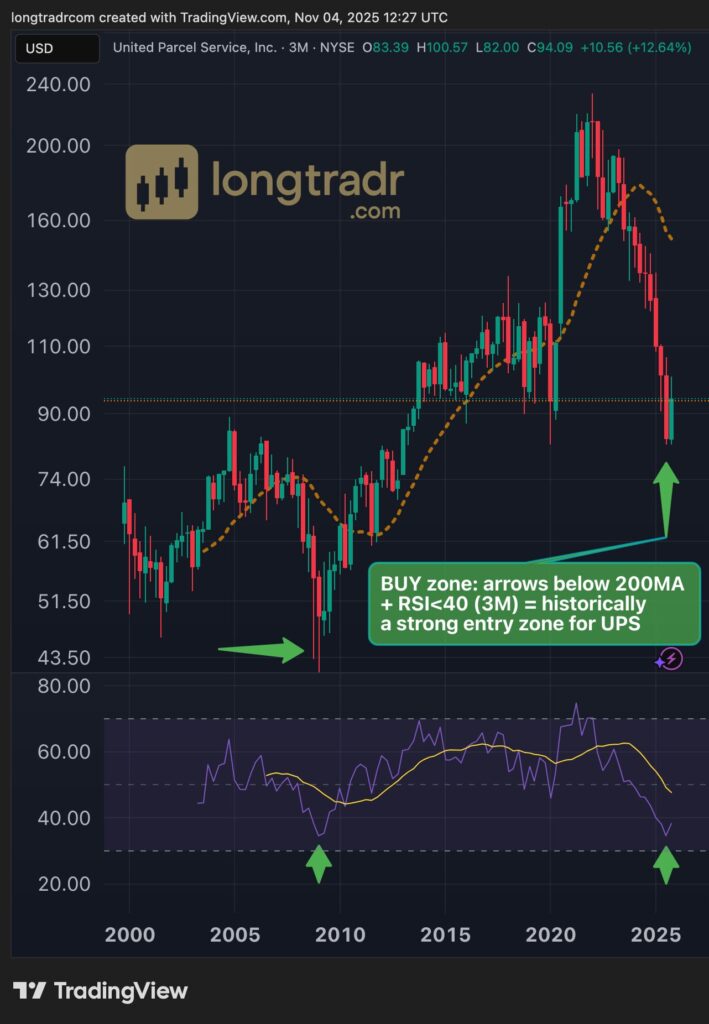
The 3-month RSI sits near oversold levels, and the share price trades below its 200-day moving average. Historically, that combination has often marked entry points when long-term fundamentals remain intact.
Why Is UPS Trading Lower?
After years of pandemic-era demand, global shipping volumes have cooled. Lower e-commerce activity, softer industrial shipments, and higher wage and fuel costs have weighed on margins. Investors also worry about slower international growth and competition from regional carriers.
From a technical view, the 3-month RSI hovering around the mid-30s suggests selling pressure could be easing. With the price below the 200-day MA, long-term investors often begin watching for signs of stabilization. While near-term results may stay uneven, UPS’s scale and network efficiency make it well-positioned once shipping demand rebounds.
Lindy Logic and What’s Ahead for UPS
UPS is a true Lindy company in the logistics world — essential, proven, and still evolving. Its long-term strategy focuses on improving efficiency, expanding automation, and balancing growth between business-to-consumer and business-to-business deliveries.
Key drivers shaping the next phase include:
- Automation & AI logistics – smart routing, predictive maintenance, and warehouse robotics to reduce costs
- Last-mile efficiency – investment in electric vehicles and route-optimization to meet sustainability targets
- Global expansion – stronger presence in healthcare logistics and cross-border e-commerce
- Dividend strength – consistent payout growth backed by solid free-cash-flow generation
- Operational discipline – tight cost control during lower-volume cycles to preserve margins
UPS may not deliver explosive growth, but it delivers something rarer: endurance. In a cyclical industry, the ability to stay profitable through downturns is its Lindy advantage.
longtradr.com Ratings
Category: Lindy Company Score
★★★★☆
With more than a century of uninterrupted operations and a vital role in global trade, UPS earns a high Lindy score. Competition and cyclical shipping demand keep it just below a perfect five, but its resilience is unquestionable.
Category: Entry Timing (RSI & MA)
★★★★☆
With the 3-month RSI near oversold and the price below its 200-day average, the current setup looks attractive for patient investors. A gradual entry could capture long-term upside as global shipping volumes normalize.
For investors who value stability, dividends, and real-world utility, UPS represents a classic Lindy opportunity — a century-old company still built to deliver.