Adobe is one of those companies that quietly shaped the modern digital world. From Photoshop and Illustrator to Acrobat and enterprise marketing tools, its software sits behind a huge part of how content is created, shared, and monetized. Founded in 1982, Adobe has spent more than four decades building products that became industry standards.
That is what makes Adobe interesting from a Lindy-effect point of view. It is not just a software company with a few strong quarters. It is a platform business that has remained relevant through multiple technology shifts, and now it is trying to do the same again in the age of AI.
Right now, the stock is still well below its old highs, which makes the longer-term technical picture more interesting than the short-term one. Instead of focusing on daily swings, the more relevant lens here is the 3-month RSI. That longer-term indicator gives a better view of whether Adobe has truly been washed out over time, and whether the market may already have priced in too much pessimism.
Why Is Adobe Trading Lower?
Adobe’s weakness over the past year has been driven less by a collapse in the business itself and more by changing expectations. Investors became more cautious when AI tools started raising questions about whether Adobe’s creative moat would weaken or strengthen. At the same time, simpler design platforms and AI-first competitors added pressure to the story.
Even so, Adobe remains a highly profitable and cash-generative business. Its core software products are still deeply embedded in creative and enterprise workflows, and the company continues to build AI features directly into that ecosystem. The market is not questioning whether Adobe matters — it is questioning how much future growth it can still command.
That is why the 3-month RSI matters more here than a short-term daily indicator. On a longer-term basis, Adobe still looks like a stock that has gone through a major reset compared with its previous valuation peak. When a company with this kind of quality trades far below former highs and the long-term momentum picture remains subdued, it can create a more interesting setup for patient investors than a simple short-term bounce signal.
In that sense, this is less about catching a quick reversal and more about asking whether Adobe is entering a zone where long-term sentiment has become too negative. For investors who think in years instead of weeks, that is often where the real opportunity begins.
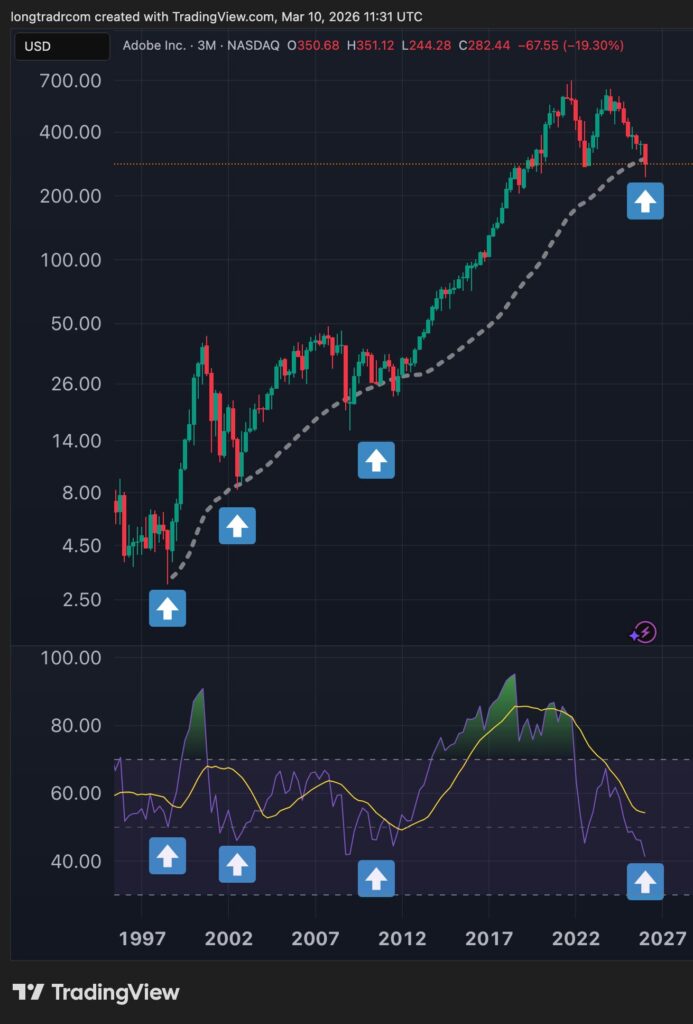
The combination of touching the 200MA with RSI levels below 50 on a three-month timeframe suggests a renewed historic opportunity.
Why Adobe Still Fits the Lindy Framework
Adobe’s strength is not built on short product cycles or temporary hype. It comes from long-term relevance. Designers, marketers, publishers, and enterprises have built their workflows around Adobe tools for decades. Switching away is costly in time, training, and compatibility — which creates quiet but powerful staying power.
This is exactly what the Lindy effect describes: the longer a company remains essential, the more likely it is to stay essential. Adobe has already survived multiple technology eras — desktop software, cloud transition, subscription models, and now the AI shift.
Its long-term position is supported by structural advantages:
- Creative ecosystem dominance – Photoshop, Illustrator, Premiere Pro, and Acrobat remain default tools in creative industries
- Workflow lock-in – teams build entire production pipelines around Adobe formats and integrations
- Recurring subscription revenue – predictable cash flow supports reinvestment and stability
- Enterprise integration – Adobe Experience Cloud connects content, marketing, and analytics at scale
- Embedded AI strategy – Firefly and AI tools enhance existing products rather than replacing them
Because of this foundation, Adobe behaves less like a fast-moving tech trade and more like a long-duration digital infrastructure asset. That makes the stock especially interesting when long-term sentiment becomes overly negative.
When a Lindy-style company trades far below former highs and long-term momentum remains subdued, history shows that patience can be rewarded. This is not about timing daily moves — it is about recognizing when long-term expectations have compressed too far.
longtradr.com Ratings
Category: Lindy Company Score
★★★★☆
With more than 40 years of continuous relevance and deep integration into global creative workflows, Adobe clearly shows Lindy characteristics within the software sector. It is not century-old infrastructure, but it has proven long-term durability in a fast-changing industry.
Category: Long-Term Entry Profile (3-Month RSI)
★★★★☆
The longer-term RSI perspective suggests Adobe has already undergone a significant sentiment reset compared with prior peaks. While not a panic-stage bottom, the setup favors gradual accumulation for investors focused on multi-year horizons rather than short-term trading.
For long-term investors, Adobe now sits in an interesting middle ground: not a momentum darling, not a broken story, but a durable platform company trading in a more skeptical market environment. That combination often becomes attractive when viewed through a multi-year lens.