Some software companies solve a problem. Others slowly become part of how entire corporations operate. That is the category ServiceNow (NOW) has entered. Founded in 2004, the company started with IT workflow automation but gradually expanded into HR, customer service, security operations, and enterprise-wide digital workflows.
Today, many large organizations rely on ServiceNow as a central operating layer for internal processes. That type of integration creates a powerful Lindy-style characteristic: the deeper a platform becomes embedded into daily operations, the harder it becomes to replace.
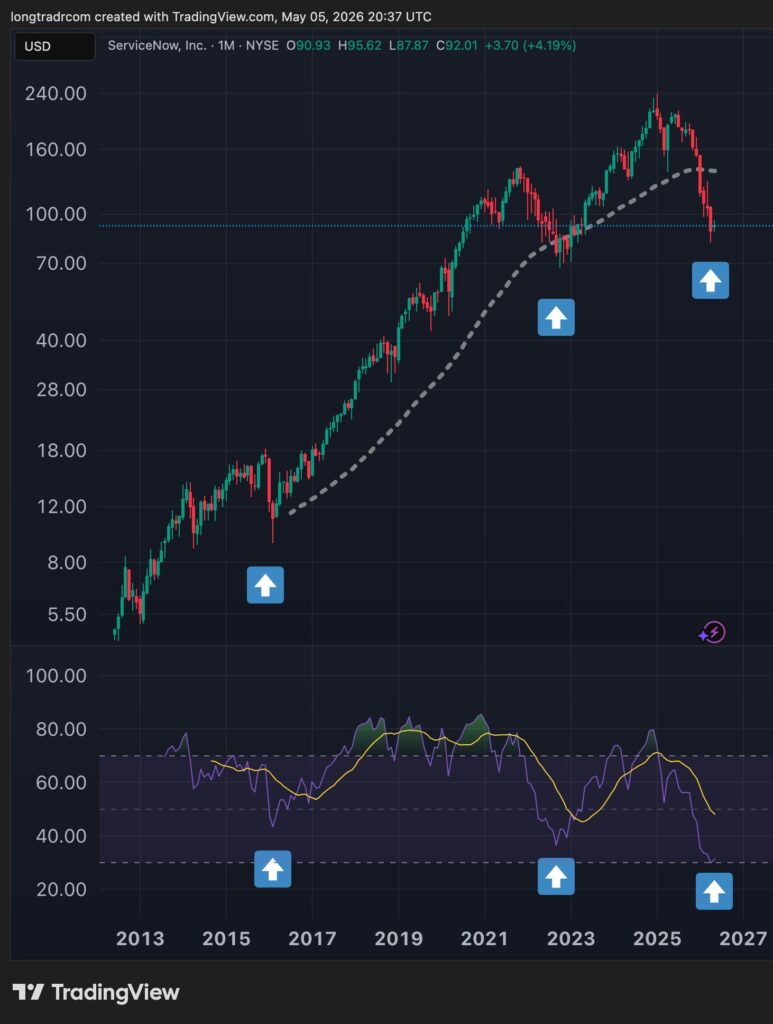
Recently, however, the stock has cooled after a strong multi-year run. The 1-month RSI has moved toward lower territory, while the price trades below the 200-day moving average. Historically, this combination can become interesting when high-quality software companies experience temporary sentiment resets without a major deterioration in the underlying business.
Why Is ServiceNow Trading Lower?
The pressure on ServiceNow is largely tied to valuation and macro sentiment rather than a collapse in demand. After years of strong growth, investors became more selective toward expensive software names as interest rates stayed elevated and AI competition intensified across the tech sector.
At the same time, expectations for enterprise software remain extremely high. Even strong earnings reports can lead to volatility if growth slows slightly or guidance does not exceed already-optimistic forecasts. That creates periods where quality companies retrace even while the long-term business story remains intact.
From a technical perspective, the 1-month RSI approaching weaker momentum territory suggests that recent selling pressure may be stabilizing. Combined with price trading below the 200-day moving average, the stock is entering an area where longer-term investors often begin paying closer attention.
This does not automatically mean the stock has bottomed. But for companies with durable enterprise ecosystems and recurring revenue, periods of temporary weakness can become attractive accumulation zones over time — especially when the broader structural growth story remains alive.
Why ServiceNow Has Lindy Characteristics
ServiceNow’s strength comes from integration and dependence. Once large enterprises build workflows, approvals, automation systems, and internal operations around the platform, switching away becomes difficult and expensive.
That creates the kind of operational stickiness often seen in long-lasting software platforms. While ServiceNow is much younger than traditional Lindy companies, its role inside enterprise infrastructure gives it characteristics that could support decades of relevance if execution remains strong.
Several long-term advantages stand out:
- Enterprise workflow dominance – deeply integrated into IT, HR, customer support, and operations
- Recurring subscription model – predictable cash flow and high customer retention
- AI integration potential – automation and AI assistants can strengthen workflow efficiency
- High switching costs – replacing embedded enterprise systems is operationally painful
- Large enterprise exposure – trusted relationships with major global organizations
The market’s current debate is not whether ServiceNow is useful — it clearly is. The debate is whether future growth can justify premium software valuations in a changing AI environment.
That uncertainty is exactly what can create opportunity. When a high-quality platform company trades near long-term technical support while sentiment cools, patient investors often begin evaluating the stock differently from short-term traders.
longtradr.com Ratings
Category: Lindy Company Score
★★★☆☆
ServiceNow is still relatively young compared with classic Lindy companies, but its deep enterprise integration and recurring workflow relevance give it strong long-term potential. If the platform remains essential over the next decade, its Lindy profile could strengthen considerably.
Category: Entry Timing (1-Month RSI & 200 MA)
★★★★☆
A softer 1-month RSI combined with a price below the 200-day moving average creates a more constructive setup than the momentum-driven highs seen earlier. For long-term investors, this looks more like a reset phase than a broken growth story.
For investors focused on long-duration software platforms rather than short-term hype cycles, ServiceNow represents an interesting case: a younger company with the potential to evolve into a true enterprise infrastructure staple over time.