At longtradr.com we look for companies that can endure. PayPal Holdings, Inc. (ticker: PYPL) has been a pillar of digital payments for more than two decades. Launched in 1998 and scaled through the 2000s, the company helped define online checkout, peer-to-peer transfers and merchant acceptance worldwide.
Because PayPal has stayed relevant through multiple tech cycles — from desktop e-commerce to mobile and now embedded payments — it can be viewed as a Lindy effect stock. The longer a platform remains useful, the more likely it is to keep attracting users and partners.
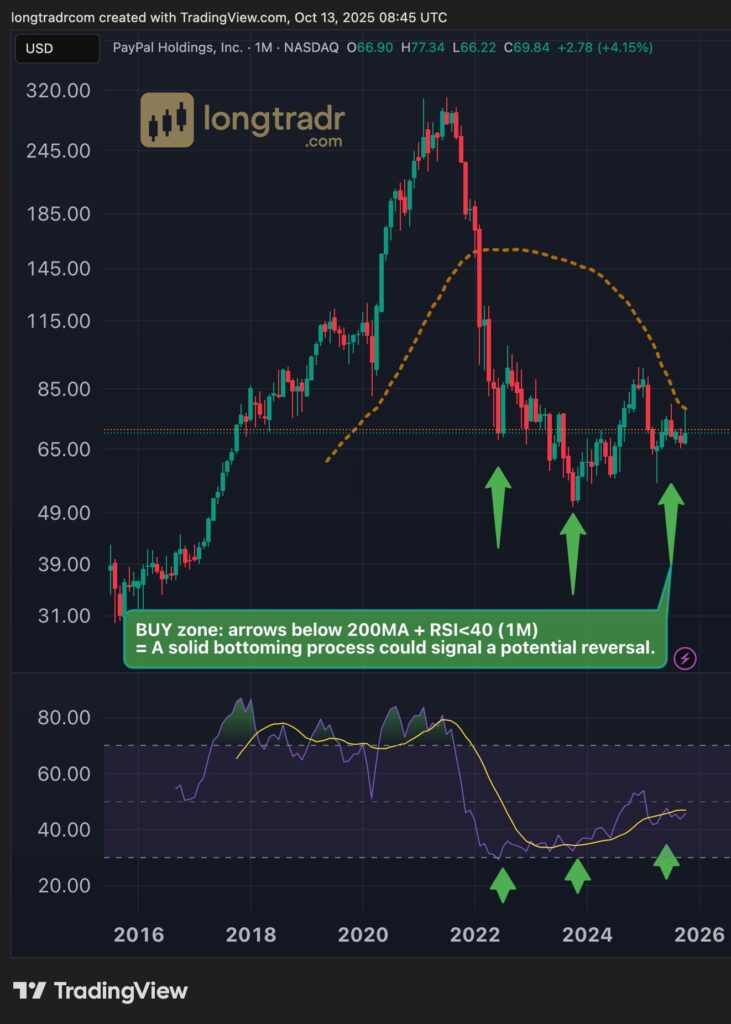
Right now, the stock looks out of favor, which can create opportunity. The 1-month RSI is at a low level, signaling weak momentum. The share price is trading around or below the 200-day moving average after recent swings. Historically, that combination has often marked attractive entry zones for long-term investors when fundamentals stabilize.
Why Is PayPal Trading Lower?
In October 2025, PYPL traded in the high-60s to mid-70s after a sharp drop during a broad market sell-off. Investors have been cautious for several reasons:
- Mixed sentiment on growth vs. profitability: PayPal’s user base and total payment volume remain large, but the market wants faster revenue growth and clearer margin expansion.
- Competition: Apple Pay, Stripe, Adyen, Block and local wallets have crowded the checkout and merchant services space, pressuring take rates and marketing spend.
- Execution reset: The company is re-engineering parts of its stack and trimming costs, which is positive long-term but creates near-term uncertainty.
- Risk-off markets: Cyclical shifts toward megacap AI and away from fintech have weighed on sector multiples.
Even so, the technical picture is improving under the surface. After rallying above the 200-day moving average briefly, the stock pulled back with the market and now trades near that long-term trend line. A low 1-month RSI alongside a price that is hovering around/below the 200-day MA often precedes mean-reversion when fundamentals are intact. That does not guarantee an immediate rebound, but it can set the stage for accumulation over time.
Lindy Logic and a Strong Pipeline
PayPal’s Lindy case rests on utility and network effects: a trusted brand at checkout, a massive consumer and merchant base, and rails that tie into marketplaces, platforms and small businesses. The company is also refreshing its growth playbook.
Key near-term and medium-term drivers to watch:
- Retail media & monetization: PayPal is launching an Ads Manager so its small-business merchants can run retail-media style campaigns. This opens a new, high-margin revenue stream on top of payments.
- Product velocity: Faster iteration across checkout, consumer app, and merchant tools (fraud, authorization, settlement). Small UX lifts at scale can raise conversion and take rate.
- Cost discipline: A restructuring program targets lower run-rate costs and a leaner tech stack. Over time this supports margin expansion and cash generation.
- Partnerships & geographic rails: Deeper integrations with local payment systems and platforms can widen acceptance and lower frictions for cross-border commerce.
Put simply: PayPal is trying to be more than a utility at the button — it wants to be a monetizable network for merchants and brands while remaining a trusted wallet for consumers. If execution lands, operating leverage can follow.
longtradr.com Ratings
Category: Lindy Company Score
★★★☆☆
PayPal has survived more than 25 years of change — from early e-commerce to mobile and embedded finance. It shows Lindy traits for a tech company, but not the century-long resilience of older firms. A balanced mix of disruption and durability earns it three solid stars.
Category: Entry Timing (RSI & MA)
★★★☆☆
The 1-month RSI is weak and price is near/below the 200-day average — a setup that has often preceded rebounds when fundamentals improve. Given macro and competition, a staged entry approach makes sense.
For long-term investors who believe digital commerce will keep expanding, PayPal remains a key gatekeeper with multiple ways to create value. The story now is execution: if new products and retail-media monetization gain traction while costs fall, the stock can re-rate from depressed levels.